How Do You Learn Best?
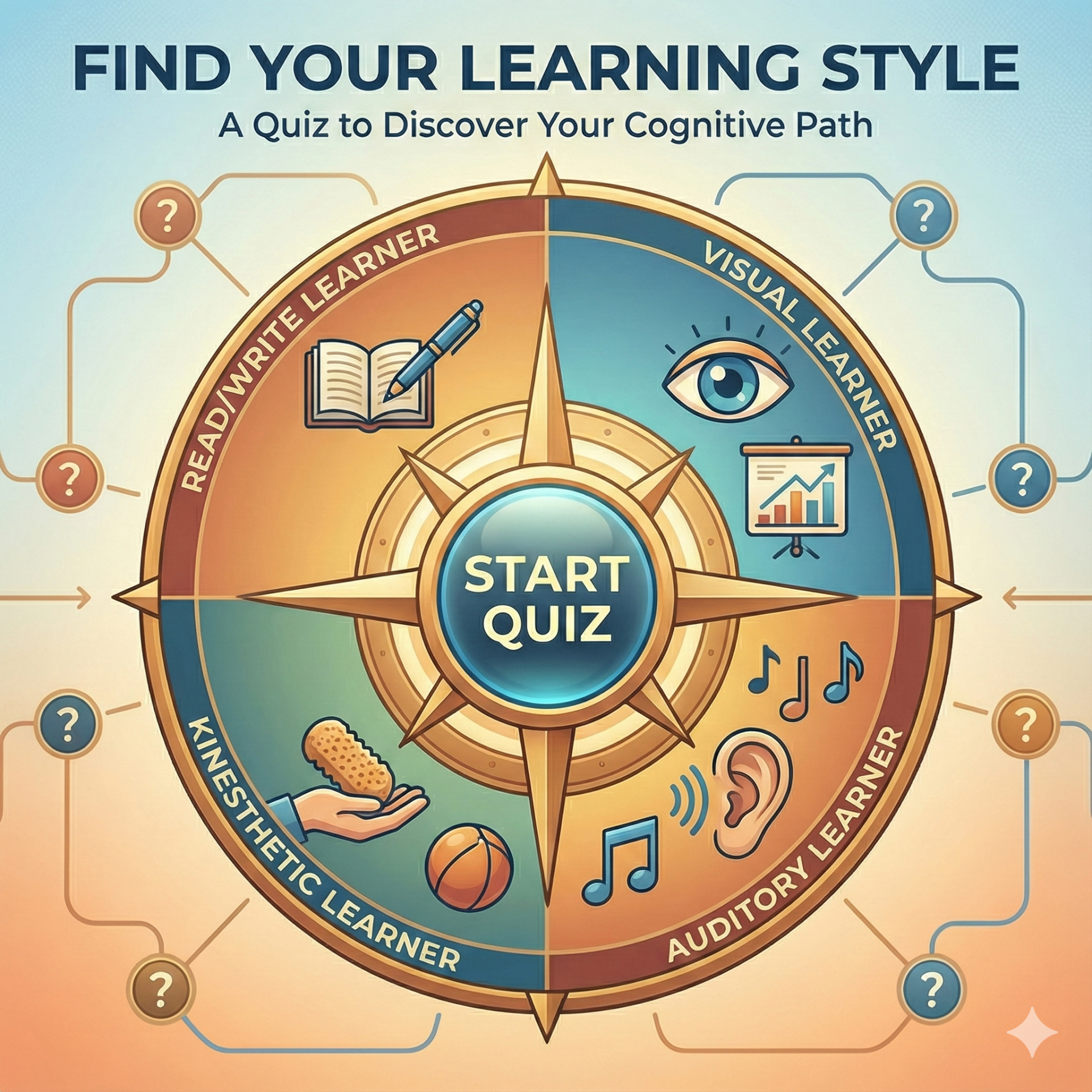
This assessment uses the four standard learning styles: Visual, Aural, Read/Write, and Kinesthetic. Answer the questions to find your Primary and Secondary styles.
Here is the printable handout and checklist designed specifically for the VARK (Visual, Aural, Read/Write, Kinesthetic) version of the quiz.
I have tailored the strategies to be actionable for students in a creative or academic setting.
STUDENT LEARNING PROFILE: THE VARK MODEL
Name: __________________________________ Date: ____________
PART 1: MY RESULTS
Record your scores from the assessment below.
- [ ___ ] Visual (Observation & Diagrams)
- [ ___ ] Aural (Listening & Speaking)
- [ ___ ] Read / Write (Text-based)
- [ ___ ] Kinesthetic (Doing & Practicing)
My Primary Style is: __________________________________ My Secondary Style is: _________________________________
PART 2: STRATEGY CHECKLIST
Review the strategies below based on your results. Check 2-3 boxes that you commit to trying for this class.
1. If you are a VISUAL Learner:
- You prefer to learn by seeing. You like graphs, charts, diagrams, and symbols.
- [ ] Color Code: I will use different colored highlighters or fonts to organize my notes by topic.
- [ ] Convert Text to Images: I will turn bullet points into flowcharts, diagrams, or sketches to help me remember them.
- [ ] Visual Review: I will look at the photos/diagrams in the textbook before reading the text to get an overview.
- [ ] White Space: I will leave plenty of white space in my notes so I can draw arrows and connections later.
2. If you are an AURAL (Auditory) Learner:
- You prefer to learn by listening and speaking. You process information by talking it through.
- [ ] Record & Replay: I will record lectures (with permission) or read my own notes into a voice recorder to listen to later.
- [ ] Discussion: I will find a study partner to talk through complex concepts or critique ideas verbally.
- [ ] Read Aloud: When proofreading my writing, I will read it out loud to catch errors my eyes might miss.
- [ ] Explain It: I will test my understanding by trying to explain the concept to someone else (or to an empty room).
3. If you are a READ / WRITE Learner:
- You prefer to learn by reading text and writing notes. You like lists, handouts, and manuals.
- [ ] Re-Write Notes: I will rewrite my class notes into a more organized format after class.
- [ ] Detailed Lists: I will use numbered lists and bullet points to organize my tasks and thoughts.
- [ ] Captions: I will turn diagrams and charts into words by writing a detailed description of what they show.
- [ ] Extra Reading: I will read the optional articles and handouts provided, as seeing it in print helps me “get it.”
4. If you are a KINESTHETIC Learner:
- You prefer to learn by doing. You rely on trial and error, practice, and real-world examples.
- [ ] Practice First: I will try to do the task (or a practice version) before reading the full theory behind it.
- [ ] Real Examples: I will look for real-world case studies or examples of the concept in action.
- [ ] Short Bursts: I will study in short blocks of time with frequent breaks to move around.
- [ ] Trial & Error: I will use a “sandbox” file to experiment with tools and buttons just to see what they do.
PART 3: MY REFLECTION
How can I use my Secondary Style to support my Primary Style? (e.g., If I am Kinesthetic but need to read a textbook, maybe I can walk around while reading).
__________________________________________________________________________________
__________________________________________________________________________________
- Disclaimer: This assessment is designed for educational and self-reflection purposes only. It is not a clinically validated psychological evaluation and should not be used as a substitute for professional mental health advice or diagnosis. The results are intended to offer insights and foster personal growth, not to define your character or limit your potential.*
