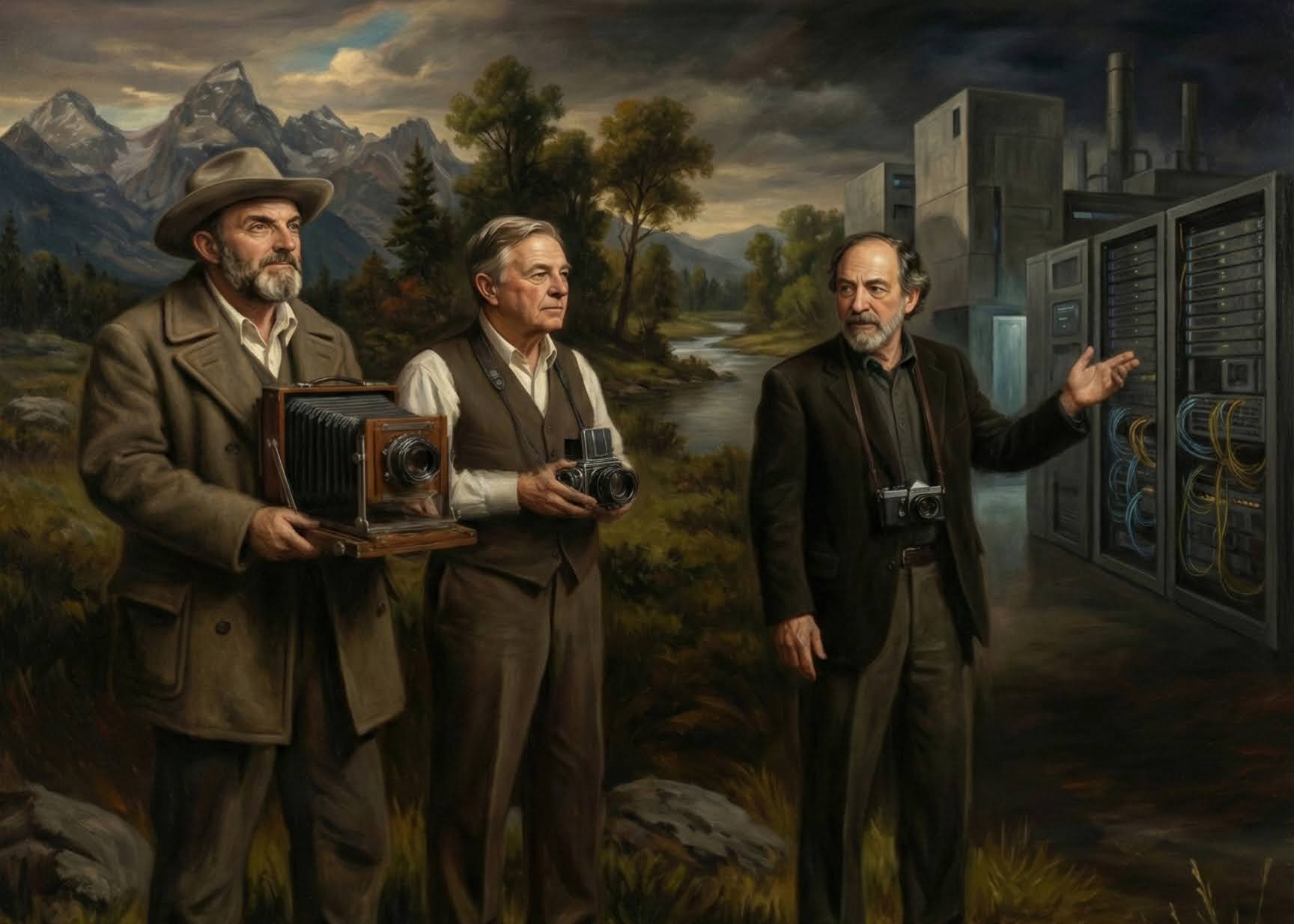
by Ira Gardner (2025)
Topic: The radical shift in 20th-century American landscape photography—contrasting the majestic, spiritual wilderness of Ansel Adams with the stark, objective “New Topographics” movement.
Episode Overview
For decades, the iconic vision of the American West was defined by Ansel Adams: towering mountains and untouched wilderness that served as a spiritual ideal. But while Adams captured these majestic vistas, a different reality was taking shape—one of tract homes, parking lots, and suburban sprawl. In this episode, we explore the profound transition from the “Sublime” to the “New Topographic” movement, a shift that forced us to face the land we actually live in.
Key Movements & Figures
1. The Era of the Sublime: Ansel Adams
The first half of the 20th century was dominated by Ansel Adams, whose work was a search for “transcendence” and “redemption” through nature.
- Aesthetic Goal: To capture the “sublime” and the humbling exaltation of untouched wilderness.
- The Zone System: Trained as a concert pianist, Adams brought a “virtuoso” discipline to the darkroom. He compared a photo’s tonal range to the 88 keys of a piano, insisting that a photographer must be able to “play” them all.
- Previsualization: Adams championed the ability to know exactly how the final print would look before clicking the shutter.
- Activism: His photography was a “weapon for preservation,” used to lobby President Roosevelt to establish Kings Canyon National Park.
2. The Shift: New Topographics (1975)
By the 1970s, a new generation of photographers challenged the “myth” of the pristine West, focusing instead on “human imposition”. This shift was cemented by the 1975 exhibition, New Topographics: Photographs of a Man-Altered Landscape.
- Robert Adams: Documented the “compromise” of nature, focusing on tract homes and “roadkill” along the Rocky Mountains. He sought a “basis for hope” even amid construction.
- Lewis Baltz: Known for “cold objectivity” and “formal austerity”. His work documented industrial parks and “dirt piles” as symbols of a “creeping soullessness”.
- Stephen Shore: Notable as the only color photographer in the original exhibition, focusing on the visual density of American car culture.
- Joe Deal & Henry Wessel Jr.: Deal used high vantage points to flatten perspective into geometry, while Wessel employed a “soft eyes” snapshot aesthetic to find poetry in the mundane, like muffler shops.
Theoretical Frameworks
- John Szarkowski’s 5 Characteristics: As MoMA’s Director of Photography, Szarkowski validated the movement by defining photography’s unique qualities:
- The Thing Itself: Recording a real subject.
- The Detail: Compelling clarity.
- The Frame: What is included versus eliminated.
- Vantage Point: How where you stand determines the truth.
- Time: Capturing a single, fleeting moment.
- Influences: The movement borrowed heavily from Pop Art (specifically Ed Ruscha’s documentation of gas stations) and 19th-century pioneer photography.
Key Takeaways & Refractions
- The End of the Frontier: The transition marked the moment America realized the “innocent” wilderness was gone.
- Tough Love: This wasn’t a cynical rejection but a “clear, unflinching look at a world that is both cherished and deeply flawed.”
- The Quest for Hope: Despite the starkness, photographers like Robert Adams sought to find redemption and beauty in the way light falls even on a flawed, man-made world.
Notable Quotes
“The negative is the composer’s score and the print is the conductor’s performance.” — Ansel Adams
“Objectivity became his shield against despair.” — Discussing Lewis Baltz
“The dream of this innocent, untouched wilderness—it was over. Now we had to learn to live in and find meaning in the world we ourselves had made.” — John Szarkowski
