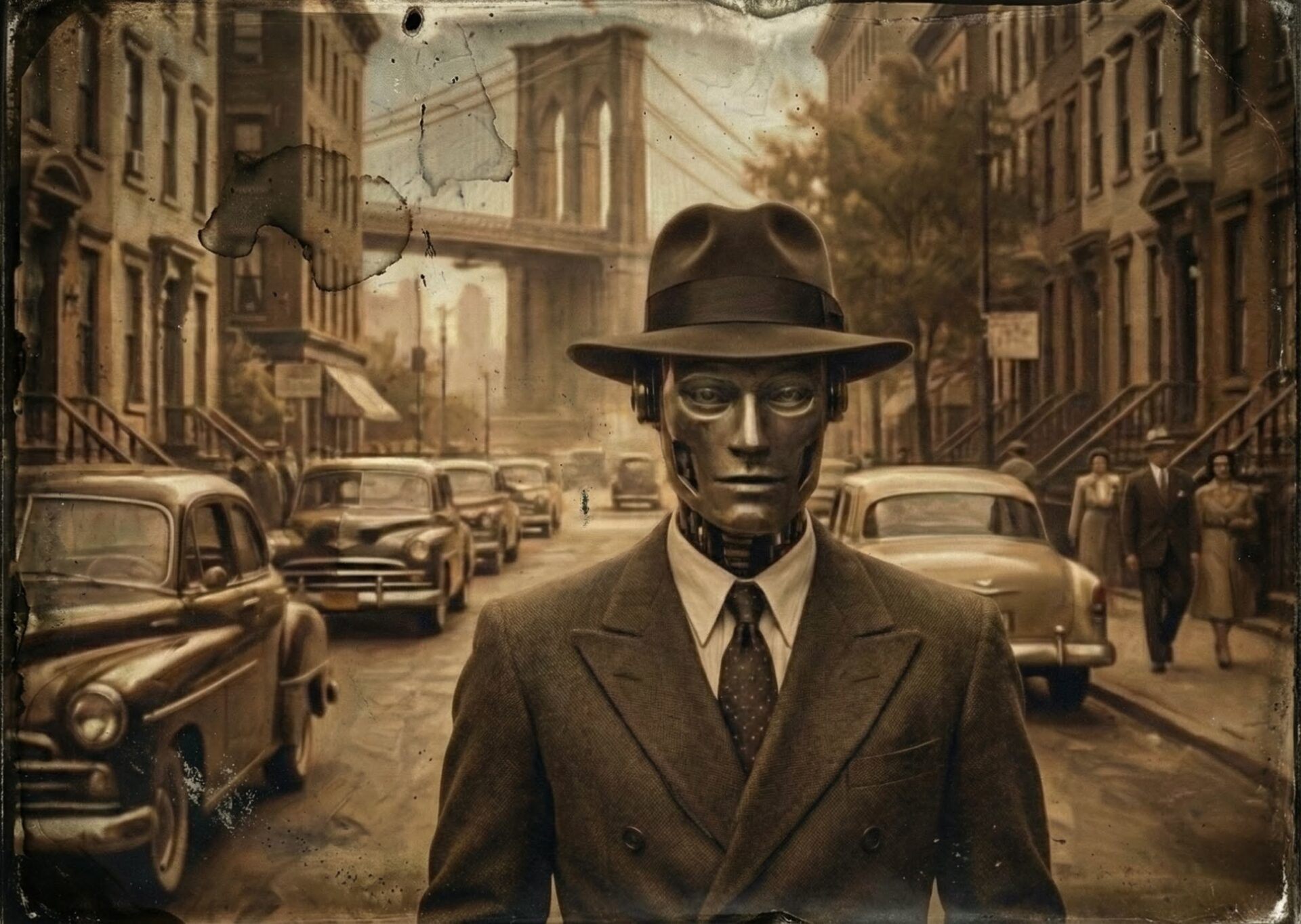
Core Theme: Decoding the invisible “language” of images—from ancient Greek philosophy and 17th-century Baroque painting to modern neurobiology—to understand why human-witnessed photography resonates while algorithmic perfection often feels empty .+2
Episode Overview
We are constantly surrounded by images, but every one of them is speaking a coded language that tells our brains how to feel. This episode explores the concept of mimesis—the representation of reality—and the two primary frequencies used to build it . We investigate why a technically “flawed” photograph from the 1930s can hold more “presence” than a mathematically perfect AI image, and we provide a technical toolkit for creating work that resists the “algorithmic mirage” .+4
Key Discussion Points
1. The Two Frequencies of Mimesis
Literary critic Erich Auerbach identified two distinct styles of representing reality that apply directly to visual art:+1
- The Homeric Style (High Frequency/The Strike): Loud, bright, and fully externalized . Everything is brought into the light with no gaps or shadows, leaving nothing to the imagination (e.g., Renaissance art and modern advertising) .+4
- The Biblical Style (Low Frequency/The Echo): Quiet, shadowy, and “fraught with background” . It uses informational gaps to hint at a deeper story, inviting the viewer to fill in the blanks (e.g., Baroque painting and documentary photography) .+4
2. The Hidden Skeleton: Armatures
Every great image is built on an invisible geometric skeleton called an armature .
- Dynamic Armature: Built on sharp diagonals and 90-degree angles; it creates a “visual crash” and aggressive energy suited for the Homeric style .+3
- Harmonic Armature: Built on stable midpoints and recursive grids; it creates a “visual echo” that anchors the eye and invites quiet contemplation .+4
3. The Biology of Co-Vibration
- Mirror Neurons: Our brains contain motor cells that fire both when we perform an action and when we witness someone else doing it . They allow us to mentally simulate the experience, intention, and physical strain of the subject in a photograph .+2
- Presence vs. Observation: When an image is tuned to a universal human frequency, our mirror neurons create an internal simulation of that experience . This shift from mere observation to internal participation is what we call presence.+1
4. The Human Signature: The Glitch
- The Punctum (Roland Barthes): A small, often accidental detail—a scuff on a shoe or a tired look—that “pierces” the viewer and proves a real human witness was present .+1
- The Stutter: Human art is defined by meaningful imperfection (grain, motion blur, or unresolved shadows) . Because AI has never risked anything, it cannot authentically simulate the “creaturely vulnerability” of a real person encountering the real world .+3
5. The AI Trap: Recursive Mimesis
Generative AI is a master of the Homeric frequency but fails to create presence because it performs recursive mimesis—copying trillions of human-made copies rather than looking at the real world . It over-renders every pixel, eliminating the informational gaps and shadows necessary for human brains to engage and “co-vibrate” .+3
A Recipe for a Powerful Image
To create work that has presence, the host suggests a four-step “Eidos Lab” process:+1
- Choose the Intent: Are you aiming for a heroic strike (Homeric) or a persistent echo (Biblical)? +1
- Tune the Armature: Use aggressive diagonals for action or stable midpoints for contemplation.+1
- Balance the Notan: Ensure the “void” or negative space carries as much narrative weight as the subject .+1
- Introduce the Glitch: Fracture the perfection to prove the image is a witness to a real physical encounter .+1
Notable Quotes
“The machine can have perfection. The human purpose is to find the silence between the lines.”
“To make an image that truly has presence, you have to have the courage to withhold some of the light.”
Suggested Reading List
- Erich Auerbach, Mimesis: The Representation of Reality in Western Literature (1946): The foundational text for understanding the “Homeric” and “Biblical” styles of representation .+1
- Roland Barthes, Camera Lucida: For a deep dive into the “Punctum”—the piercing, vulnerable detail that makes a photograph human .+1
- René Girard: To understand “Mimetic Desire” and how images are used to manufacture aspiration in modern culture .
- Arthur Wesley Dow, Composition: The book that introduced the Japanese concept of Notan (the harmony of light and dark) to the West .
- Jay Hambidge: For the technical principles of Dynamic Symmetry.
- Myron Barnstone: A key teacher for the principles of the Harmonic Armature.
- James Bridle: For a modern look at how computation can simulate reality while losing human understanding.
