This morning as I listened to a podcast interview of National Geographic photographer Sam Abell, I was struck by how his words so clearly reflected the research into photographic composition I have been doing for the last 30 years.
Abell described the difference between a quiet and loud composition as being the difference between an image that has stopping power versus staying power. As a photojournalist he wielded a 35mm camera but used it as if it were a large format 4×5 camera, taking his time to see the composition. He described his process of building a composition through a process of layering from background to foreground. Counterintuitively to most photographers he spoke about the need to identify the background first and to compose it from the farthest distance first, slowly determining each layer that would lead to the foreground. Once the scene was composed he would wait for the subject to appear.
There is a quote from the Estonian biologist and philosopher Jakob von Uexküll, specifically from his 1934 book A Foray into the Worlds of Animals and Humans: With a Theory of Meaning where he writes:
“The spider weaves its web before it has ever met a physical fly… the two perceptual worlds of the fly and the spider are absolutely un-communicating, and yet so perfectly in tune that we might say that the original score of the fly… acts on that of the spider in such a way that the spider’s web can be called ‘fly-like’ although the spider has never seen a fly.”
This “unknowing” harmony of the photographer and the subject is vital to the creative process for every kind of candid photograph ranging from street photography to landscape photography. It is like making a movie by constructing the set and waiting for the actor to appear.
Abell would go on and describe the process he used to combine stopping and staying power within a single frame. Through conversations with Danish wildlife photographer Torben Nissen he realized that the hierarchy of an image exists that includes the background, the portrait, and the gesture. Another way of interpreting this is as the background, subject, and gesture. The two of them developed a dialogue around the idea of a micro-composition, the composition within the composition that elicits a co-vibration with the viewer but whose meaning is only truly known by the photographer. I think Abells concept of the micro-composition describes perfectly the idea of punctum that the French Literary critique Roland Barthes wrote about in his book Camera Lucida.
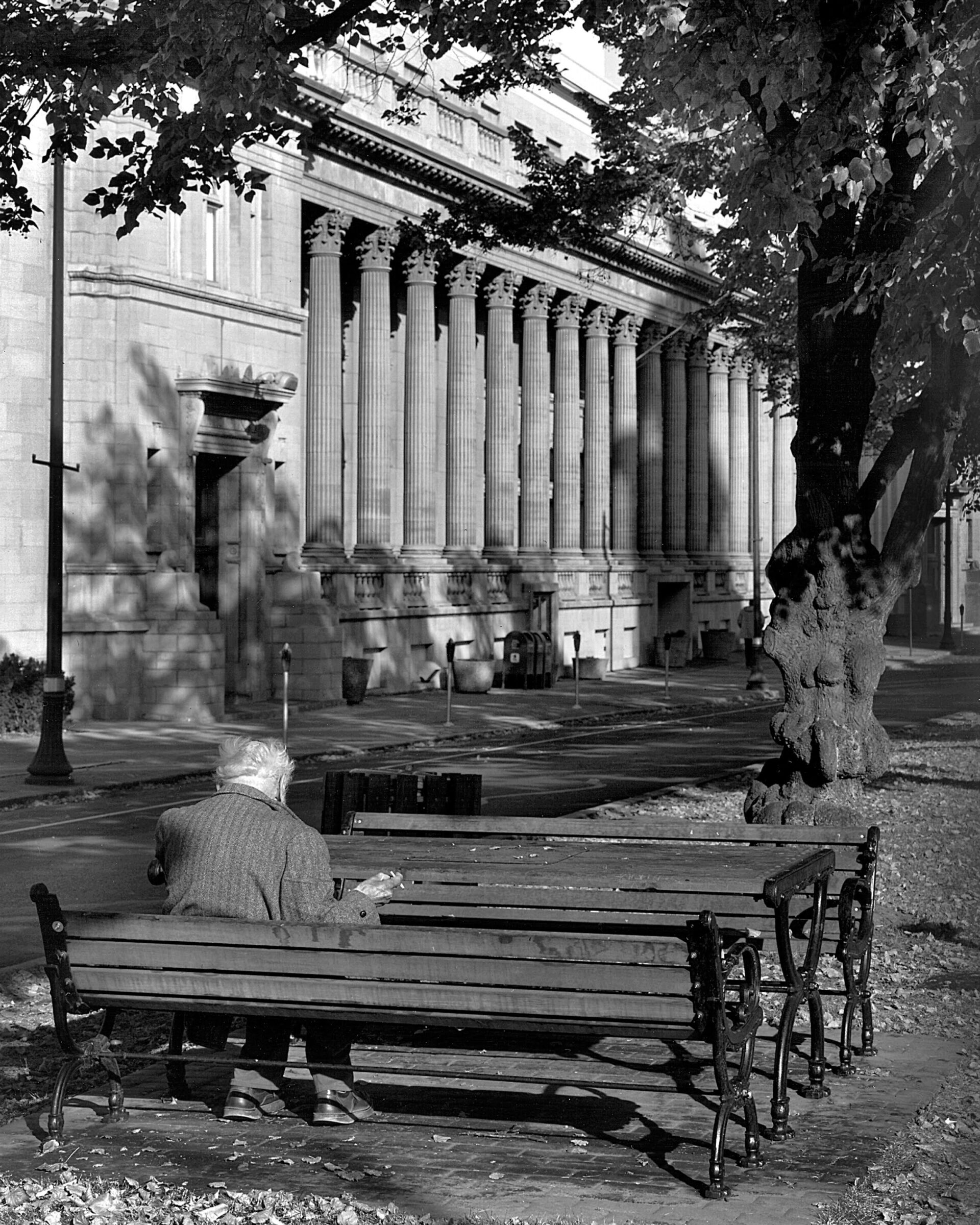
While I could write a dissertation on these ideas and dive deeper into the concepts of frequency and co-vibration, that will have to wait for another time. What came to mind from all of this conversation was this image I made back in October of 1988.
I was in my second year of college in a photography program that mandated the use of 4×5 cameras for every assignment. I had gone downtown with my camera and girlfriend and selected a location on Riverside Avenue to set up my camera. My original intention was to photograph the classical greek/roman columns in front of the Masonic Temple and I had chosen a spot on the grassy median between the two lanes of traffic. I wanted to frame the columns with the branches and fall leaves of a tree and had selected a park bench to be my foreground element. Unwittingly I had begun to approach my photography with Sam Abell’s layered approach.
Thankfully, I was using a cumbersome 4×5 camera that took time to set up, compose, and focus. As I pulled my head out from under the dark cloth an old man approached me and asked me if I had a light for the cigarette he had just picked up off the ground. I happened to have a lighter on me so I gave it to him and he thanked me and proceeded to walk right in front of my camera and take a seat on the park bench. At first I was concerned that my shot would be ruined! I had carefully planned out my composition and had spent half an hour getting everything set up. I wondered how long I would have to wait for him to leave. I worried that he might just stay their indefinitely and curl up on the bench and go to sleep. Then suddenly my whole body felt a jolt of energy. I suddenly recognized that he wasn’t ruining my image, he was making my image into art!
That epiphany has stuck with me ever since. I try to photograph the relationship of the landscape and man whenever possible. I think it is an effort to cultivate a sense of presence in my photographs as a means of inviting the viewer to experience empathy.
I also realized that it was the gesture of holding the cigarette in his hand, the angle of his legs that led down to the worn shoes, and the balance of light and dark that created an arresting photograph. The punctum of this image (for me) is the dark edge of a metal checkerboard that was screwed into the wooden top of the picnic table. Nobody would know it was there if they hadn’t visited that exact spot. I was drawn to the table and the idea that it was a place for quiet passage of time in the company of another playing a game of checkers or chess.
Later in my father’s darkroom as I made the original 16×20 print using a cold light enlarger on fiber paper I realized that I had my first great photograph. The cold light brought in the luminous of the leaves in a way the condenser enlargers at college could not.
During college I studied the work of Ansel Adams and worked to master the darkroom techniques needed to produce great work. I remembered reading how Adams had said that if at the time he died he had produced 10 great works, then he would have had a successful life. When I made this print I felt like I had my first one. It would be decades before I would create another one.
The image I have posted here was made from a scan of a smaller 8×10 print. I recently came across the original sepia toned print when I was clearing out his office before selling my parents house to move her into mine while we built her a new cottage on our property. I was touched that he still had that print and now it is hanging on the wall just outside my office door at the college where I teach photography and filmmaking.
Wisdom it seems, comes when youthful intuition and tenacious effort finally meet old age and understanding.