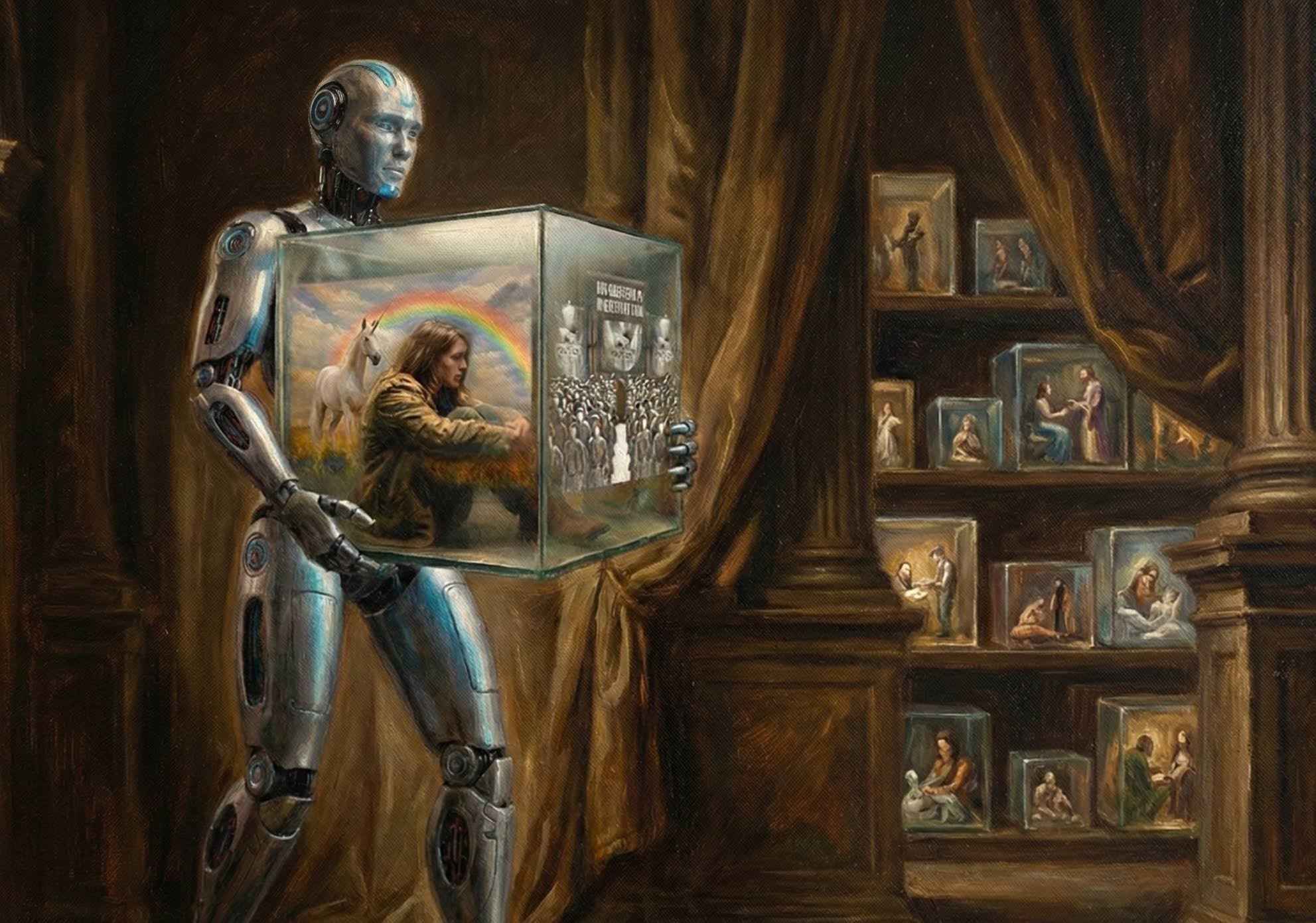
Episode Summary
In this episode of Eidos, we host a “modern dinner party” for the ideas of German existentialist philosopher Martin Heidegger. We explore his seminal essay, The Age of the World Picture, and discuss how the modern era is defined by a massive transition in Western thought: the shift of the “seat of truth” from the divine to the human subject.
We unpack how this shift turned the world into a “picture”—a structured, represented system that we stand before and observe, rather than a mystery we inhabit. From the “standing reserve” of digital data to the “flight of the gods” in modern culture, we examine the cost of our drive for total mastery and calculation. Finally, we look at how the humanities and analog artistic practices, like the silver gelatin darkroom process, serve as vital sites of resistance.
The Five Pillars of Modernity
Heidegger identifies five interconnected phenomena that uphold the modern world, all stemming from a deeper metaphysical change:
- Science as Research: Science becomes an active, aggressive procedure that “interrogates” nature, forcing it to fit into pre-designed mathematical models.
- Machine Technology: Not just tools, but an autonomous transformation of practice that actively shapes how we live and behave.
- Art as Aesthetic Experience: Art moves from seeking objective or divine truth to becoming an object of mere subjective experience and feeling.
- Culture as a Human Project: Society becomes a managed endeavor to realize specific values and goals determined by human subjects.
- The Loss of the Gods: The divine loses its objective footing in the cosmos and is reduced to an internal “religious experience” that can be studied psychologically.
Key Discussion Points
- The World Becomes a “Picture”: In the modern age, the world is staged for us. It becomes a coherent system that we represent, order, and calculate.
- Man as the “Subjectum”: For the first time, humanity becomes the central point from which everything else gets its meaning and measure.
- The Standing Reserve (Bestand): We explore how reality is converted into a “resource” on call. A river becomes hydroelectric power; a person becomes a collection of social media metrics and data points.
- The Incalculable Shadow: As our calculations become more exact (the “Gigantic”), the actual mystery and “being” of the world disappear into a shadow that we cannot measure.
- Calculative vs. Meditative Thinking: We contrast the “calculative” engine of modern efficiency with “meditative” thinking—the act of dwelling, questioning, and listening to the world without a goal.
The Art of Resistance
Here is a list of artistic approaches across various mediums designed to resist the “World Picture” and cultivate the “Incalculable Shadow.”
1. Photography: The Aesthetics of the Latent Image
In a world of instant digital feedback, mystery is restored through material resistance and the unseen.
- Long-Form Analog Processes: Utilizing large format or silver gelatin processes where the image remains “latent” (invisible) for days or weeks. This introduces a “temporal shadow” between the act of seeing and the act of possessing.
- The “Obscura” Technique: Intentionally using underexposure or deep shadows where the subject is not fully “pictured.” This forces the viewer to dwell in the darkness rather than consume the subject.
- Physical Intervention: Manipulating the negative or the print surface (chemigrams, mordançage). By introducing chemical “accidents,” the artist admits that they are not in total control of the “eidos.”
2. Literature: The Poetics of Lacunae
If the “World Picture” demands a user manual, mystery in literature requires the unsaid.
- The Lacuna (The Gap): Writing stories or essays that leave central events off-page. This forces the reader to inhabit the space of the “Incalculable” to find meaning.
- Non-Linear Narratives: Eschewing the “cause-and-effect” logic of modern research. By breaking the timeline, the author restores the feeling of the world as a labyrinth rather than a grid.
- Apophatic Writing: Describing things by what they are not. This mirrors the “flight of the gods” by acknowledging that the most profound truths cannot be named directly.
3. Cinema and Film: The “Slow Cinema” Movement
Modern media uses rapid editing to keep the viewer “engaged” (captured as a resource). Mystery requires duration.
- The Long Take: Holding a shot far past the point of information delivery. When a shot continues after the “action” is over, the viewer begins to notice the “Being” of the room or the landscape.
- Off-Screen Sound: Using sound to suggest a world that the camera (the “picture-maker”) cannot see. This restores the sense that reality is larger than what is being represented.
- Tactile Textures: Emphasizing the grain of 16mm or 35mm film. The physical “noise” of the medium acts as a veil, preventing the “transparent” mastery of the subject.
4. Painting and Visual Arts: The “Non-Finito” and Encaustic
Mystery thrives in depth and incompleteness.
- The Non-Finito (The Unfinished): Leaving works in a state of “becoming.” This prevents the work from being a “closed” object or a finished “picture,” keeping the “Mystery of Creation” visible.
- Pentimento: Allowing previous layers of a painting to show through the surface. This reveals the “history” of the work as a process of hidden layers rather than a flat, final result.
- Encaustic or Glazing: Using layers of wax or translucent oil to create physical depth. The viewer must look through a medium to see the form, mimicking the way truth is often concealed.
5. Sound and Music: The Use of Silence and Dissonance
If data is constant noise, mystery is found in the intervals.
- The “Negative Space” of Silence: Integrating long silences that demand the listener attend to their own presence in the room.
- Field Recordings of the “Inaudible”: Using contact microphones to record the “hum” of the earth or the vibration of a bridge—sounds that exist but are usually outside the “human picture.”
- Dissonance and Resolution: Avoiding easy, “calculable” melodies that the brain can predict, instead using intervals that remain “unresolved,” leaving the listener in a state of questioning.
Summary of the “Mystery-Driven” Approach
| The “World Picture” Approach (Calculative) | The “Mystery” Approach (Meditative) |
| Transparency: High-definition, clear, solved. | Opacity: Shadows, grain, ambiguity. |
| Speed: Instant, consumable, efficient. | Duration: Slow, latent, demanding. |
| Mastery: The artist as “Creator-God.” | Listening: The artist as “Witness/Scriptor.” |
| Information: Telling the viewer what to think. | Presence: Inviting the viewer to “dwell.” |
Notable Quotes
“The world was conquered as a picture.”
“We stop encountering things when we start encountering inventory.”
“The most important things in life are exactly those things that cannot be pictured, measured, or sold.”
Resources Mentioned:
- The Age of the World Picture by Martin Heidegger
- The Question Concerning Technology by Martin Heidegger
- The poetry of Friedrich Hölderlin
Poems of Friedrich Hölderlin
The Course of Life by Friedrich Hölderlin
You too wanted better things, but love
forces all of us down. Sorrow bends us more
forcefully, but the arc doesn’t return to its
point of origin without a reason.
Upwards or downwards! In holy Night,
Where mute Nature plans the coming days,
doesn’t there reign in the most twisted Orcus
something straight and direct?
This I have learned. Never to my knowledge
did you, all-preserving gods, like mortal
masters, lead me providentially
along a straight path.
The gods say that man should test
everything, and that strongly nourished
he be thankful for everything, and understand
the freedom to set forth wherever he will.
