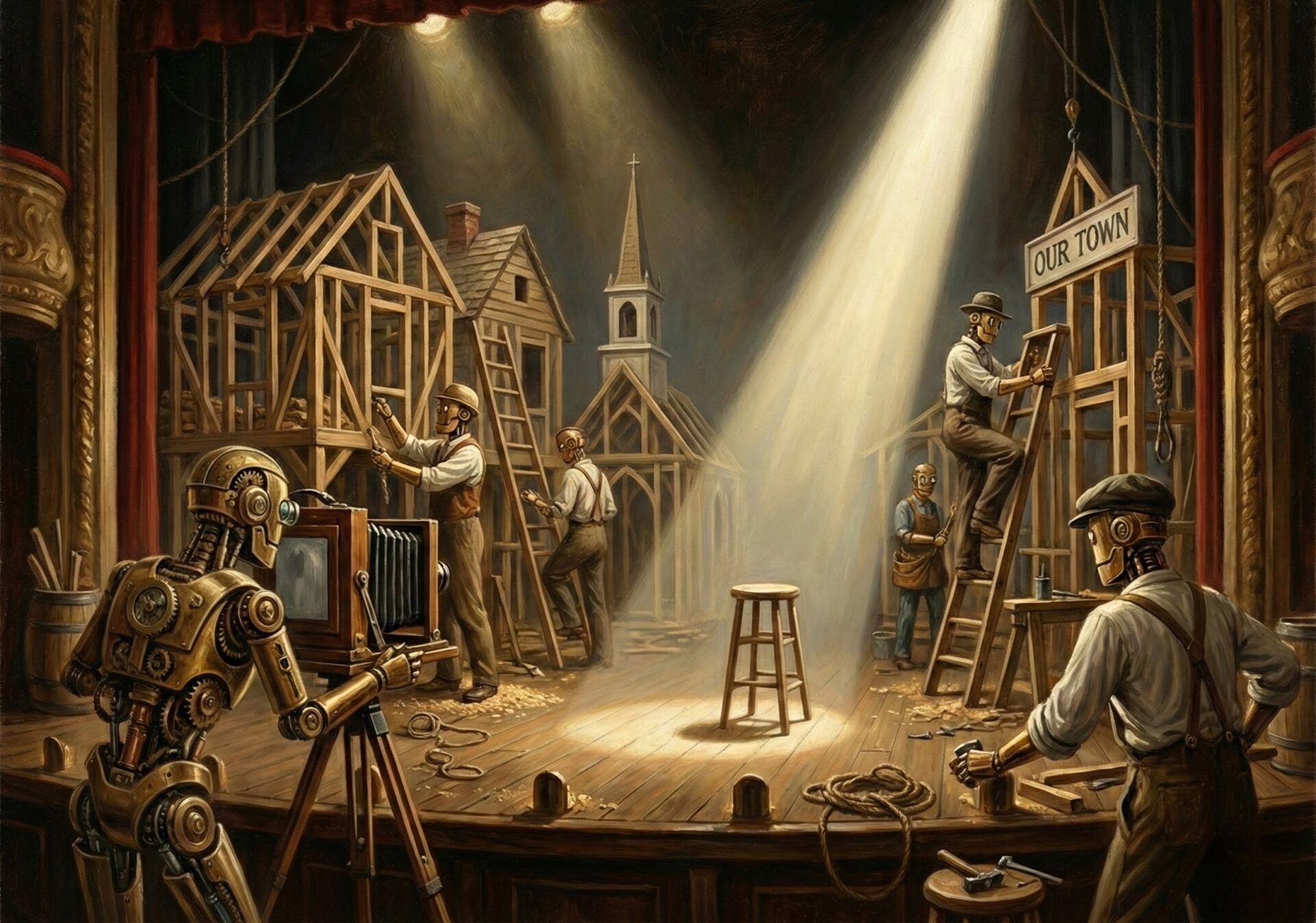
In this episode of Eidos, we explore the ideas of legendary photographer Sam Abel and examine how great photographs are meticulously built like a spider web waiting for the subject to appear. We also look at the hidden secret ingredient that gives a photograph depth and originality.
Core Concepts
- Stopping Power vs. Staying Power:
- Stopping Power: The immediate, loud, and graphic “wow factor” that grabs attention but often fades quickly.
- Staying Power: A quieter, structurally sound quality built through rigorous composition that invites long-term exploration and remains relevant for years.
- Stopping Power: The immediate, loud, and graphic “wow factor” that grabs attention but often fades quickly.
- Compose and Wait: A strategy where the photographer first finds a compelling “stage”—characterized by great light and strong geometry—and then waits for a subject to enter and complete the frame.
- The Photographer’s DNA: The idea that every photograph is a self-portrait, reflecting the creator’s life history, books read, and personal experiences as an unconscious filter for perception.
- The Private Punctum: Unlike Roland Barthes’ theory of a detail that stings the viewer, this is a secret detail known only to the photographer—a personal truth that the entire composition is built to protect and sanctify.
The Three-Layer Hierarchy
Developed through the collaboration of Sam Abell and Torben Nissen, this framework creates images that possess both energy and structural rigor:
- The Setting (Background): The foundational “silence” that must be able to stand alone as a strong image.
- The Portrait (Subject): The human connection or presence that bridges the background and the action.
- The Gesture (The Moment): A fleeting spark of life or movement that provides the “stopping power”.
Meticulous Techniques
- The Hand Test: A diagnostic tool where you cover the main subject with your hand; if the remaining background isn’t a strong, balanced photograph on its own, the image lacks staying power.
- Back-to-Front Layering: Building a photograph starting from the farthest distance (horizon/sky) and slowly adding layers forward to create depth.
- Micro-Composition: Making tiny, obsessive adjustments to eliminate “visual tangents”—such as a tree appearing to grow out of a subject’s head—to give elements “stature and dignity”.
Suggested Reading List
- Sam Abell, Stay This Moment – A seminal work and exhibition catalog that codified Abell’s painterly, layered style and his philosophy on the “eloquence of the ordinary”.
- Jakob von Uexküll, A Foray into the Worlds of Animals and Humans (1934) – Specifically the metaphor of the “spider and the fly,” which illustrates how two systems can be in perfect, unknowing harmony.
- Roland Barthes, Camera Lucida – The source of the “punctum” theory, which the episode reframes as a “private anchor” for the creator.
Listen to an interview with Sam Abell here:
