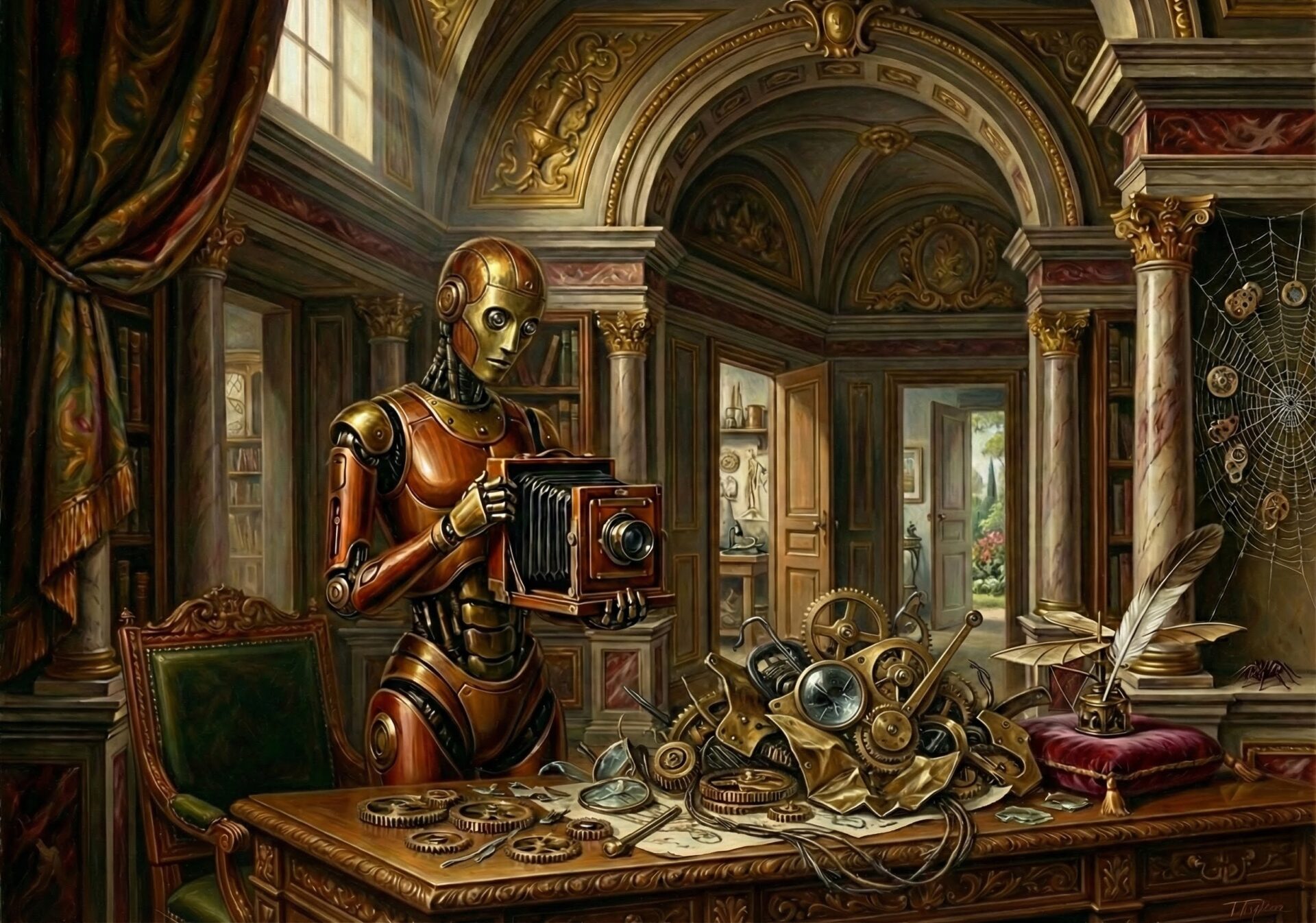
In this episode we tackle the universal dread of the blank canvas through the lens of theoretical biology and the work of Stuart Kauffman. We explore how the universe builds complexity and how those same principles can serve as the ultimate antidote to creative paralysis.
We look at how self imposed creative constraints can lead to artistic innovation.
Core Concepts from Stuart Kauffman
Our guide for this episode is Stuart Kauffman, a theoretical biologist and MacArthur “Genius” Fellow. His work at the Santa Fe Institute suggests that innovation isn’t about total freedom, but about working within the “messy” world right in front of us.
- The Paradox of Choice: Absolute freedom often leads to “creative drowning”. When you can do anything, you often end up doing nothing.
- The Adjacent Possible: Innovation is never a giant leap; it is always just one step away from what already exists. Think of it as a house: you can only enter the rooms (possibilities) for which there are immediate doors. Once you step into a new room, a whole new set of doors appears that were previously invisible.
- Exaptation (The Happy Accident): This occurs when a feature evolved for one job is hijacked for a completely new purpose.
- Biological Example: Feathers originally evolved for warmth (thermal regulation) but were later “exapted” for flight.
- Creative Example: Guitar distortion was originally a technical failure of overloaded circuits, which musicians then repurposed into the signature sound of rock and roll.
- Constraint Closure: Rules and limits are not hindrances; they are the scaffolding that gives work shape and life. Your style is often defined more by what you choose not to do than by what you do.
The Mindset Shift: Machine vs. Organism
The episode calls for a fundamental philosophical shift in how we approach our projects:
| The Machine Model | The Organism Model |
| The creator is a master/commander. | The creator is a collaborator/participant. |
| Follows a rigid, predictable blueprint. | Listens and responds to what the work “wants” to become. |
| Seeks total control and dominion. | Embraces “non-ergodic” surprises and unfolding. |
The Creative Toolkit
- Stop waiting for the lightning bolt. Look for the immediate “adjacent possible” door you can open right now.
- Embrace the error. If a tool breaks or a glitch occurs, don’t just hit “undo”—ask if the broken version has a better, unexpected function.
- Build yourself a box. If you are stuck, add more constraints (e.g., use only three colors or a one-hour time limit) to force your creativity into new channels.
Your Challenge
Go find a project you previously abandoned as a “failure”— a blurry shot, or a rejected film edit. Look at the mistake and ask: What if this is not a error, but an exaptation waiting to happen? Think of a way to use your camera to create something beyond it’s original intent. Operate at the edge of the medium and explore how to break the rules.
“The task is not to see what has never been seen before, but to think what has never been thought before about that which is seen by everyone.” — Arthur Schopenhauer (as cited by Stuart Kauffman)
exaptation definition
/ˌekˌsapˈtāSHən,ˌeɡˌzapˈtāSHən/
noun
Biology
- the process by which features acquire functions for which they were not originally adapted or selected.
