Episode Summary
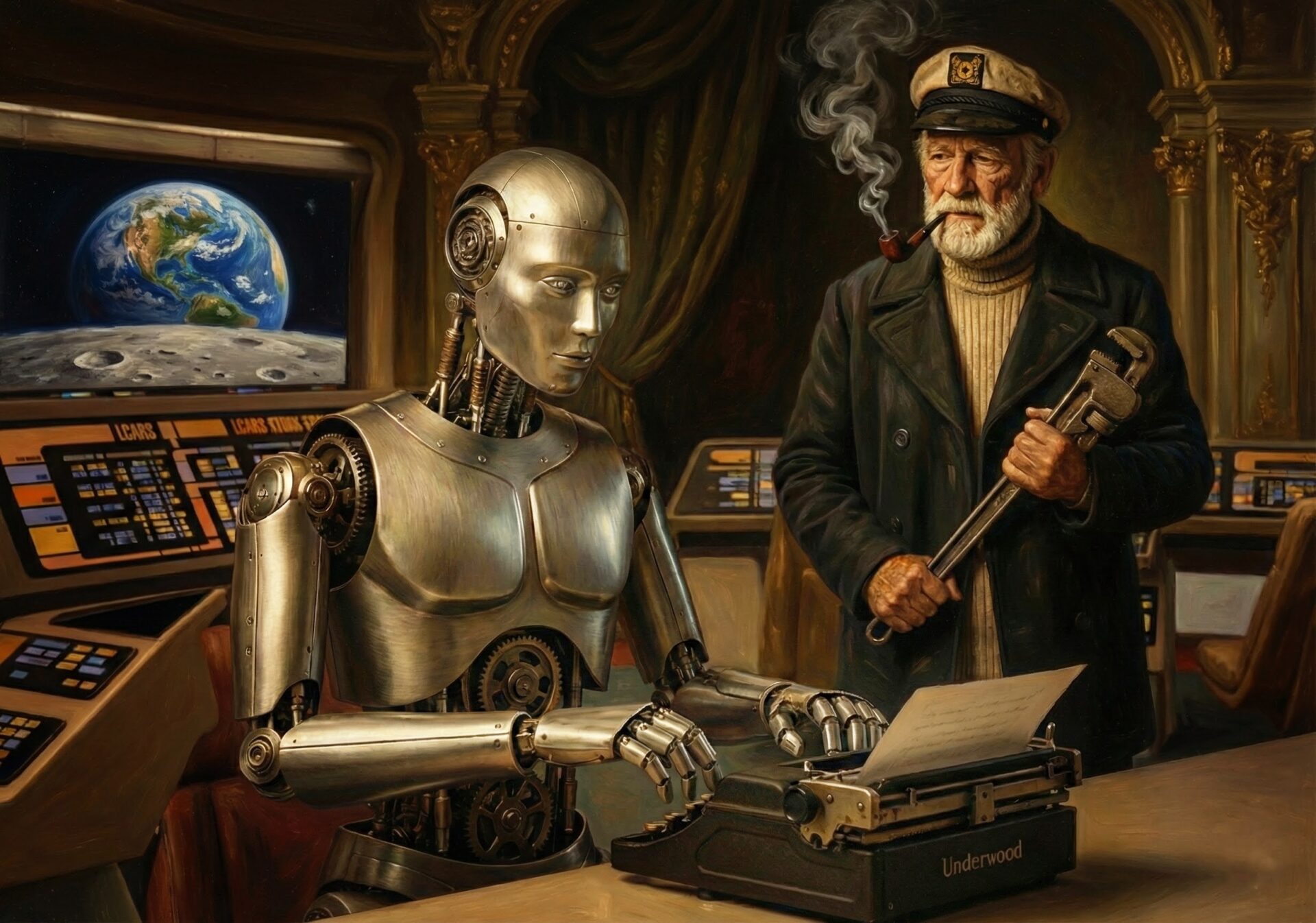
In this episode, Eidos takes a deep dive into the evolution of our relationship with technology. We explore a personal narrative, co-authored by Ira Gardner with AI, to trace the shift from a tactile, mechanical world to an abstract, screen-mediated one. The conversation explores the concepts of “Qualia”—the felt sense of reality—and the vital role human expertise plays in collaborating with generative AI.
Key Discussion Points
- The Mechanical Era: Memories of a childhood shaped by the physical tools of the 1970s, from Star Trek’s mechanical set designs to the intricate work of camera repair.
- The Technological Shift: How the introduction of the flexible printed circuit board in cameras like the Canon AE-1 marked the end of an era of tactile repair and the beginning of “remove and replace” technology.
- Star Trek as Metaphor: Contrasting the bridge of Kirk’s Enterprise—a “cramped submarine full of physical switches”—with the serene, screen-dominated bridge of Picard’s Enterprise-D.
- The AI Collaboration: A look at the “Dual-Processor Workflow,” where the AI provides structural history while the human supplies visceral, lived experience (“Qualia”).
- The Human Role as Editor-in-Chief: Why humans must act as the “fact-checking firewall” to counteract AI’s tendency toward “fluency heuristics” and hallucinations.
The “Editor-in-Chief” Protocol for AI Content
To ensure accuracy when working with AI, the episode suggests a three-step protocol:
- Classification: Distinguish between safe arguments (subjective/philosophical) and vulnerable data (specific names, dates, specs).
- Zero-Shot Verification: Never ask an AI to check its own work. Use a fresh chat or a search engine to verify facts independently.
- Manual Audit: Personally verify all citations to ensure the sources actually exist.
