Host: Ira Gardner Guest: Cindy Groepper – Artistic Polymath and Wet Plate Photographer
Episode Overview
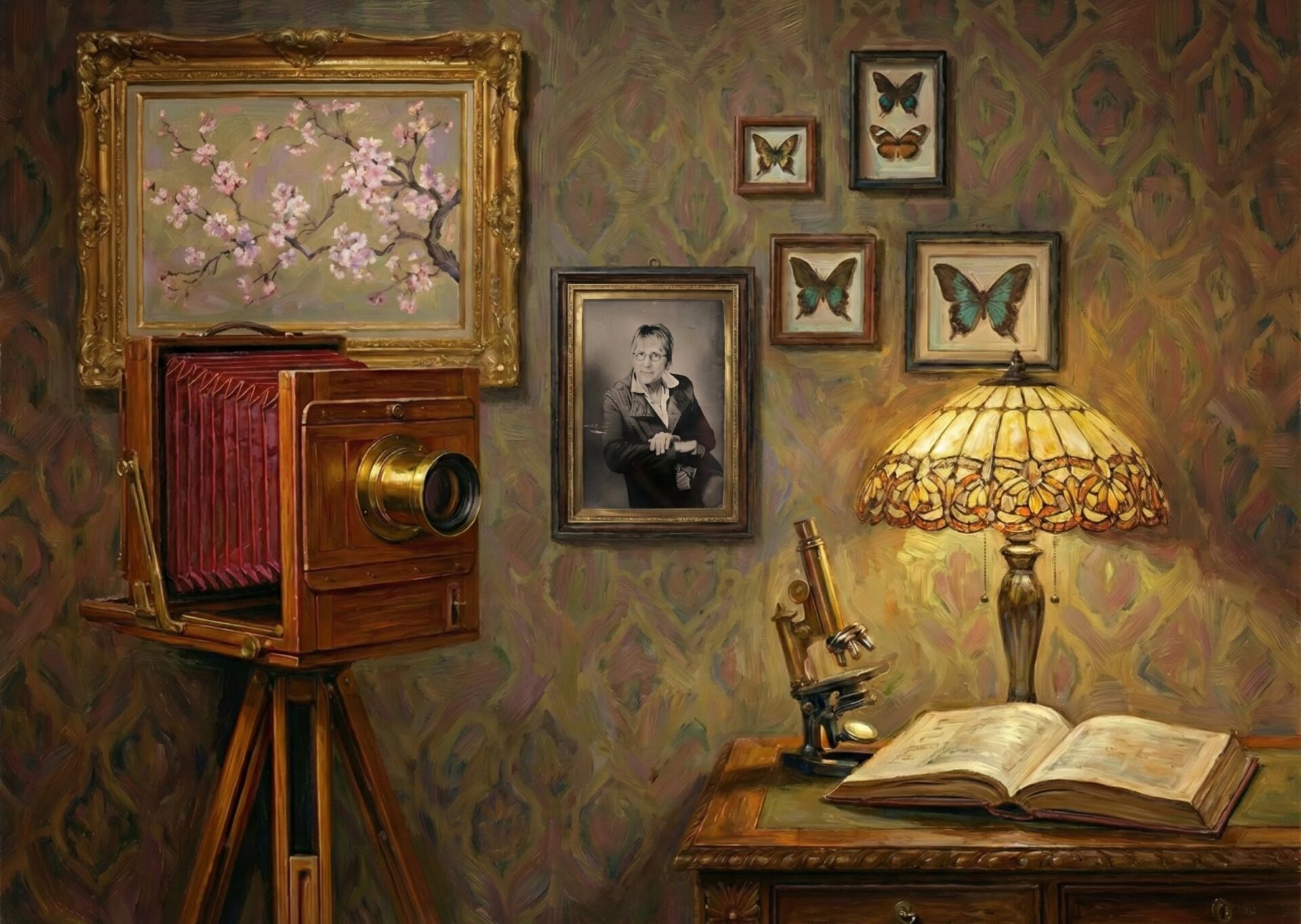
In this archival interview from 2017, host Ira Gardner sits down with Cindy Groepper to explore the hands-on, often unpredictable world of wet plate photography. A retired nurse turned “intuitive artistic polymath,” Cindy discusses her journey from a basic Christmas kit to studying with masters of the craft. The conversation delves into the unique aesthetic of tintypes, the challenges of long-exposure portraiture, and how her background in nursing and an interest in Victorian science inform her hauntingly beautiful still life compositions.
The Guest: Cindy Groepper
Cindy Groepper’s life on a ten-acre rural property in Spokane is a tapestry of diverse interests, from dressage and horseback riding to letterpress printing and fabric art.
- Artistic Training: She studied wet plate photography under Luther Gerlach and polymer plate photogravure under Ray Bidegain.
- Local Mentorship: After getting her start, she was mentored by Dr. Gregory Roth at Spokane Falls Community College, who encouraged her to seek out workshops with experts like John Coffer.
- Studio Curiosities: Her home studio is filled with antiques, taxidermy, and medical curiosities that serve as props for her thematic explorations of Romanticism and the Enlightenment.
Key Discussion Points
1. The Appeal of the Process
- Handmade & Tactile: Cindy is drawn to the process because everything is done by hand from start to finish.
- The “Forgiving” Flub: Unlike some mediums, if a plate is “flubbed,” it can be washed off and reused—a form of artistic recycling Cindy uses to test exposure times.
- Earthy Texture: She describes the final result as having an “earthy” and “old-timey” feel that modern digital photography cannot replicate.
2. Embracing Imperfection
- Chemical Sovereignty: In wet plate, perfection is elusive; the artist must relinquish control to the chemicals.
- “Satellites” and Striations: Cindy discusses the beauty found in technical “errors,” such as “particulate” on the plate or silver striations that can look like rain in a finished portrait.
3. The Art of the Still Life and Portrait
- The Sitter’s Challenge: Portraiture is difficult due to long exposure intervals—sometimes up to 15 seconds—requiring the subject to remain perfectly still while facial muscles naturally twitch.
- Botanical Studies: Inspired by artists like Karl Blossfeldt, Cindy uses wet plate to perform botanical studies, noting the deep investment of time required to grow the sunflowers she eventually photographs.
- Biographical Influence: Her career as a nurse informs her “Vanitas” still lifes, featuring skeletons and hands—reminders of human mortality and the tactile nature of her former profession.
4. Technical Nuances
- Orthochromatic Vision: Wet plate is orthochromatic, meaning it “sees” color differently; red records as nearly black, while blue skies appear very light.
- Exposure as an Investment: Cindy reflects on the slowing down required by the medium, where a single image represents months of preparation and planning.
Notable Quotes
“I love it because it’s tactile. It’s everything you do from start to finish, you do by hand.”
“In wet plate, you can’t get perfection. You get what you get… it’s sort of like whatever the chemicals do for you, for your picture, is what you get.”
“The poet in me says it looks like it’s raining.” (On silver striations in a portrait)
anscripts.
