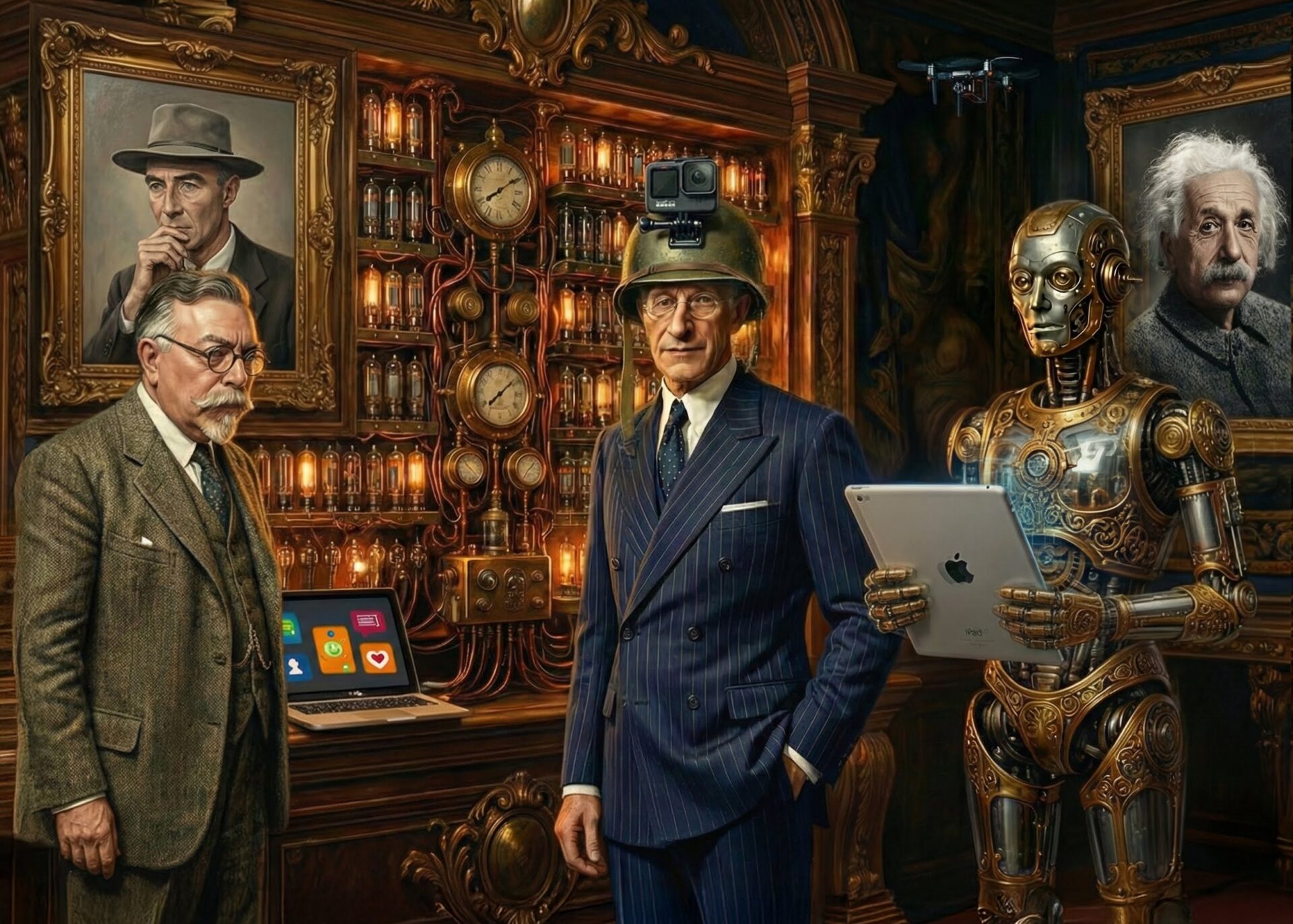
Topic: An exploration of Vannevar Bush’s landmark 1945 essay, “As We May Think,” and its profound influence on modern technology and artificial intelligence.
Episode Overview
In the summer of 1945, as World War II drew to a close, Dr. Vannevar Bush—who coordinated 6,000 of America’s leading scientists for the war effort—turned his attention from the “strange, destructive gadgets” of combat toward a new frontier: the improvement of the human mind. In his essay As We May Think, Bush identified a burgeoning crisis: a growing mountain of research that had become so specialized that investigators were bogged down by findings they could no longer grasp or remember. This episode explores his visionary solutions, his uncanny predictions of modern hardware, and the birth of associative indexing.
Key Concepts & The Memex Vision
1. The Crisis of Knowledge
- Antiquated Navigation: Bush argued that while science provided “steam engines” for physical power, methods for transmitting and reviewing knowledge remained as antiquated as square-rigged ships.
- The Mendel Example: He cited Gregor Mendel, whose foundational work on genetics was lost for a generation simply because his papers never reached the right minds.
- The Privilege of Forgetting: The ultimate goal of mechanizing the record was to allow humans to forget what they don’t need immediately, confident they can find it again instantly.
2. Hardware Predictions (1945 vs. Today)
Bush’s foresight regarding hardware was remarkably accurate and aligns with many 21st-century devices:
- Wearable Cameras: He imagined a camera the size of a walnut worn on the forehead, capable of taking snapshots in full color and stereo—a clear precursor to the GoPro.
- Dry Photography: He predicted the end of chemical processing, utilizing electron beams to create instant images.
- Extreme Compression: He projected that microphotography could reduce the Encyclopedia Britannica to the size of a matchbox, allowing a million-volume library to fit inside a single desk.
- Speech-to-Text: By combining “vocoder” technology with stenotypes, he envisioned machines that would type as a user spoke.
3. The Memex (Memory Extender)
The centerpiece of Bush’s vision was a memory extender desk equipped with translucent screens and microfilm storage.
- Associative Trails: Unlike traditional libraries that file information hierarchically or alphabetically, the Memex operated on the principle of association, mimicking the nonlinear “web of trails” in the human mind.
- The Trailblazers: Bush foresaw a new profession of “trailblazers” who would find delight in creating useful, brilliant paths through vast information for others to follow.
- The Scaffolding of Thought: Sharing a “trail” meant sharing the entire web of thought that led to a conclusion, not just the conclusion itself.
The Post-War Philosophical Rift
The realization of Bush’s ideas was deeply entangled with the rise of cybernetics, led by his MIT colleague Norbert Wiener. Their relationship shaped two competing paradigms of modern technology:
| Vannevar Bush (The Analog Pilot) | Norbert Wiener (The Cybernetic Loop) |
| Philosophy: The machine is a passive, intimate supplement to memory. It “holds your coat” while you think. | Philosophy: The human and machine are nodes in a single system or “feedback loop.” |
| Legacy: Associative indexing is the structural ancestor of the World Wide Web and how LLMs (like Gemini) navigate knowledge. | Legacy: Feedback loops and binary logic created the data storage and hardware systems necessary for automated AI. |
Historical Content Advisory
This episode discusses Bush’s 1945 essay, which uses the term “girls” to describe the workforce required for computing. At the time, the professional title of “computer” was held almost exclusively by women—highly skilled mathematicians whose contributions laid the foundations for modern computer science. We present these quotes in their historical context while acknowledging that such language diminishes their vital role.
Notable Quotes
“The methods for transmitting and reviewing knowledge remained as antiquated as square rigged ships.”
“The machine doesn’t think for you. It just holds your coat while you do the thinking.”
“Who would now place bounds on where such a thing may lead?”
