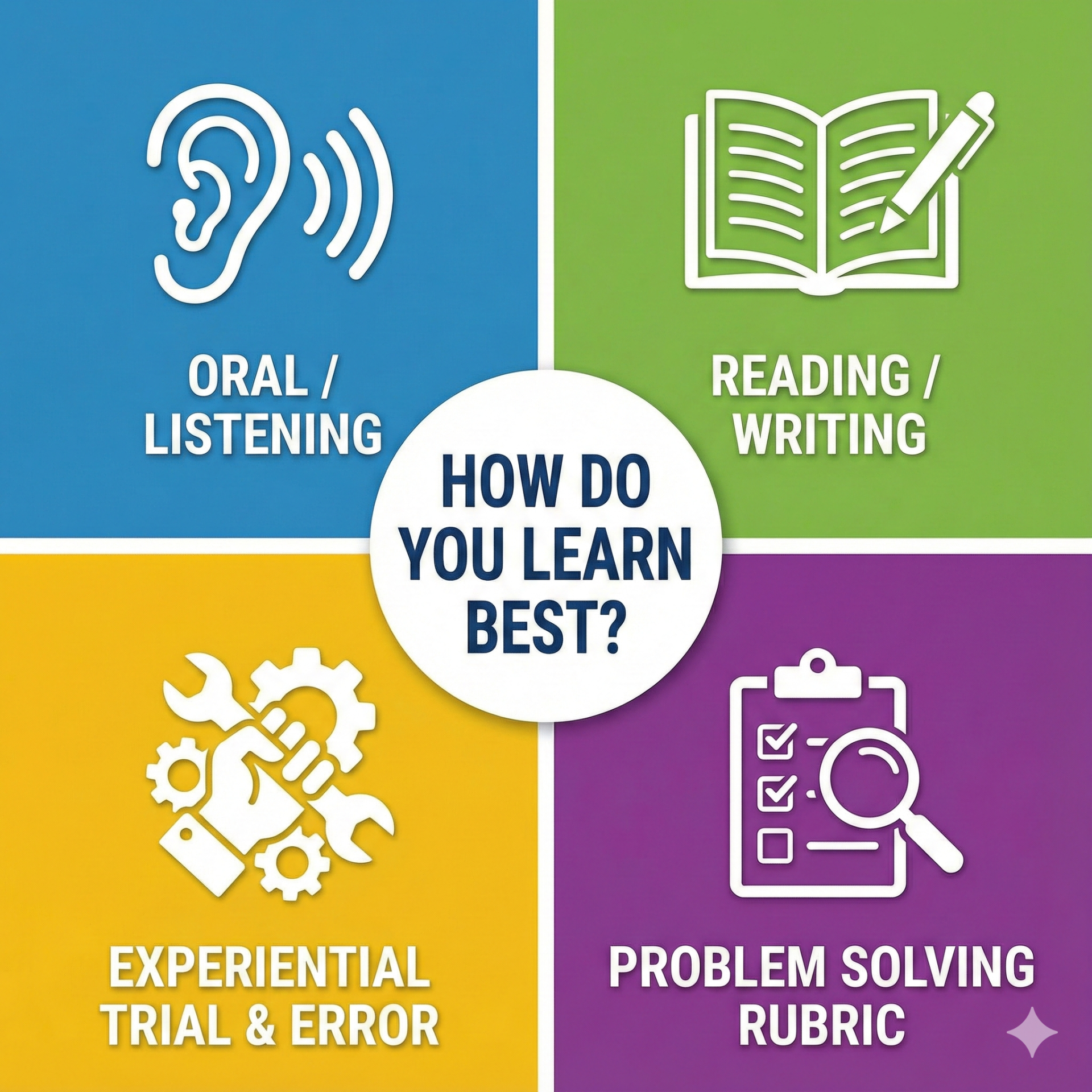
Learning Style Assessment
Answer the following 8 questions to discover your dominant and secondary learning styles.
Understanding Your Learning Style Profile
Introduction
Everyone processes new information differently. This assessment sorts your preferences into four distinct categories. Understanding your dominant style doesn’t just help you learn faster; it helps you communicate better with peers and instructors.
Use the guide below to interpret your results and find strategies to maximize your success in this course.
1. The Oral / Listening Learner (Auditory)
“I need to talk it through.”
- Who you are: You engage best when you can hear the information or discuss it. You might struggle with long periods of silent reading but thrive during lectures and group critiques.
- Key Strengths: Strong communication skills, persuasive presentation abilities, excellent memory for spoken instructions.
- Study Strategies:
- Record Lectures: Listen to them again while commuting or editing photos.
- Talk it Out: If you are stuck on a technical problem, try explaining it aloud to a peer (or even to yourself).
- Use Speech-to-Text: Dictate your initial essay drafts or artist statements instead of typing them.
2. The Reading / Writing Learner
“I need to see it in print.”
- Who you are: You prefer interacting with text. You feel most comfortable when you have a manual, a textbook, or a detailed handout. You likely take excellent notes.
- Key Strengths: Synthesizing complex information, written communication, detailed documentation.
- Study Strategies:
- Re-write Your Notes: The physical act of typing or writing out your notes helps lock the information in.
- Translate Visuals: If you see a diagram or a photo setup, write a paragraph describing it in words.
- Read Before You Do: Always read the full assignment sheet or software manual entry before you start the practical work.
3. The Experiential / Trial & Error Learner
“I need to get my hands on it.”
- Who you are: You are intuitive and tactile. You don’t want to read the manual; you want to start clicking buttons or moving lights to see what happens. You learn by failing and fixing.
- Key Strengths: Creative problem solving, fearlessness with new tools, quick adaptation to interface changes.
- Study Strategies:
- The “Sandbox” Method: Open a practice file (that doesn’t matter) and experiment wildly before working on the graded project.
- Build Models: Use physical objects to mock up lighting setups or concepts.
- Prioritize Lab Time: You need hours on the machine or in the studio more than you need hours in the library.
4. The Problem Solving / Rubric Learner (Logic)
“I need to know the requirements.”
- Who you are: You are systematic and goal-oriented. You find ambiguity frustrating. You want to know exactly what “success” looks like, how it is graded, and the logical steps to get there.
- Key Strengths: Organization, efficiency, meeting deadlines, understanding complex workflows.
- Study Strategies:
- Start with the Rubric: Read the grading criteria first. Use it as a checklist while you work.
- Create Workflows: Break a large creative project into small, logical steps (e.g., 1. Concept, 2. Shoot, 3. Import, 4. Edit, 5. Export).
- Analyze Examples: Look at previous students’ “A-grade” work to deconstruct the logic behind why it was successful.
How to Interpret Your Results
If you have a clear winner: Lean into that strategy when you are feeling stuck or frustrated. It is your “safety zone.”
If you have a tie (The Hybrid): This is an advantage! You can switch modes. For example, if you are a mix of Experiential and Reading, you might read the manual for 10 minutes, then put the book down and try it yourself for 10 minutes.
A Note on “Weaknesses”: If you scored very low in a category (e.g., Reading/Writing), do not ignore it. In a professional career, you will eventually have to read a boring contract or write a grant proposal. Use your strengths to support your weaknesses.
STUDENT LEARNING PROFILE & STRATEGY CHECKLIST
Name: __________________________________ Date: ____________
PART 1: MY RESULTS
Record your scores from the assessment below.
- [ ___ ] Oral / Listening (Auditory)
- [ ___ ] Reading / Writing (Textual)
- [ ___ ] Experiential / Trial & Error (Tactile)
- [ ___ ] Problem Solving / Rubric (Logical)
My Primary Style is: __________________________________ My Secondary Style is: _________________________________
PART 2: STRATEGY CHECKLIST
Review the strategies below based on your results. Check 2-3 boxes that you commit to trying for this class.
1. If you are an Oral / Listening Learner:
- [ ] Record Lectures: I will use a voice recorder app during demos so I can listen again while editing photos.
- [ ] The “Explain” Technique: If I am stuck on a technical problem, I will try explaining it aloud to a peer or to myself before asking for help.
- [ ] Speech-to-Text: I will dictate my initial artist statements or essay drafts to get the flow of ideas before typing.
- [ ] Office Hours: I will make a point to visit office hours to discuss complex topics verbally.
2. If you are a Reading / Writing Learner:
- [ ] Re-Write Notes: I will type up or re-write my handwritten notes after class to lock the information in.
- [ ] Translate Visuals: When I see a lighting diagram or photo setup, I will write a short paragraph describing it in words.
- [ ] Read First: I commit to reading the full assignment sheet or manual entry before touching the equipment.
- [ ] Detailed Captions: I will use detailed metadata and captions to help organize my visual work.
3. If you are an Experiential / Trial & Error Learner:
- [ ] The “Sandbox” Method: I will create a “test file” to experiment wildly with tools before working on my actual graded project.
- [ ] Physical Models: I will use physical objects to mock up lighting setups or composition ideas before shooting.
- [ ] Lab Time: I will prioritize spending extra time in the lab/studio, knowing that “hands-on” time is my best study method.
- [ ] YouTube Tutorials: I will follow along with video tutorials, pausing to do the step myself before moving on.
4. If you are a Problem Solving / Rubric Learner:
- [ ] Rubric Review: I will print the grading rubric and keep it next to me while I work.
- [ ] Step-by-Step Workflows: I will break large creative projects into a numbered list of small steps (1. Concept, 2. Shoot, 3. Edit, etc.).
- [ ] Deconstruct Examples: I will analyze “A-grade” work from previous semesters to understand the logic of why it was successful.
- [ ] Checklists: I will create my own pre-flight checklists for photo shoots to ensure nothing is missed.
PART 3: MY COMMITMENT
Based on my profile, one specific change I will make to my workflow is:
__________________________________________________________________________________
__________________________________________________________________________________
- Disclaimer: This assessment is designed for educational and self-reflection purposes only. It is not a clinically validated psychological evaluation. The results are intended to offer insights to support your creative process, not to provide a medical diagnosis or limit your potential. *
