“Composing an image is not subjective; it’s not about what you feel or how you feel things should be arranged. It is a way to organize the elements in your painting in a way that makes visual sense.” — Thomas Keglar
I opened my recent Photo Design class with this quote to challenge a common misconception: that creativity is merely a byproduct of emotional inspiration. While art may be inspired by feeling, its execution is a craft to be mastered through workman-like effort. In fact, recent research suggests that motivation is often the byproduct of effort, not its precursor. We do not wait for the “muse” to strike so we can work; we work so that the muse might find us.
Recently, I spoke with my friend Greg, a cinematographer who has filmed in over 100 countries. He noted that the most profound creativity he has encountered worldwide wasn’t found in high-tech complexity, but in craftspeople who had mastered a simple medium so thoroughly that they elevated it to a masterpiece. Complexity, in itself, is rarely creative. The disciplined repetition of simple acts is what produces profound art.
In photography, the craft that demands years of disciplined effort is composition. This was the catalyst for the development of my “Photo Design” course twenty-five years ago. At that time, photographic education was obsessed with the mechanical operation of the camera—achieving proper exposure and precise focus. The artistry was relegated to chemical recipes and the physical labor of dodging and burning in the darkroom. Unfortunately much of my time in the darkroom was spent trying to make up for the imperfections in my compositions captured in camera.
My own education had overlooked the formal craft of composing the frame. In my research, I found that the teaching of formal composition in art schools diminished during the mid-20th century, largely due to the rise of Abstract Expressionism, which valued automatic expression over geometric precision.
While I understand the modernist perspective—that an individual might intuitively arrive at craft through sheer volume of work—I believe the lack of direction often causes novice artists to abandon the path. Formal composition serves as a compass, guiding the artist toward their creative development.
After spending the first two weeks of class establishing a framework for camera operation, I asked my students what they thought the word “composition” actually entailed. They provided a brilliant list of attributes, but I was struck by one glaring omission: Framing.
The first act of any photographer is raising the camera to the eye and imposing a boundary upon a three-dimensional world. Using their omission as a starting point, we compiled a more holistic list of compositional pillars:
- The Frame: Selecting proportions (aspect ratio) to dictate the emotional “container” of the image.
- Anisotropy: Understanding visual weight and movement through the selection and placement of subjects. Factors include spatial positioning, size, and shape.
- Design Elements & Principles: The fundamental “vocabulary” of point, line, and shape.
- Armatures: The use of Dynamic and Harmonic symmetry to provide internal structure.
- Notan: The balance of light and dark values that establishes the image’s emotional “underpinning.”
- Light: The tool that creates texture, depth, dimension, and atmosphere.
- Camera Settings: The aesthetics of the “Exposure Triangle” (Aperture, Shutter Speed, ISO) and focal length, which influence movement and complexity.
- Awareness: The “ineffable” stage—the development of intuition where all senses guide the camera.
The danger of a list is that it suggests a sequence. In reality, these elements function simultaneously. One student rightly noted that it would take years to master these facets to the point of intuition. I could easily teach a twelve-week course on any single item on that list; unfortunately, I had only three hours to cover Armatures.
Beneath the surface of every great image lies a hidden skeleton. This internal geometric pattern provides the harmony the human eye instinctively craves. For millennia, artists have used armatures to replicate the perfect proportions found in the natural world.
There are two primary armatures in the Western tradition:
- Dynamic Symmetry: Known to the Ancient Greeks as Symmetria, this concept was popularized in the early 20th century by Jay Hambidge. It is based on proportions analogous to the human body and fractal patterns in nature. It creates a sense of timeless, quiet beauty and stability. It was the dominant structure in the era of 4×5 and 8×10 cameras, as the 4:3 proportion is optimized for this armature and these cameras came closest to it.
- Harmonic Symmetry: With the advent of 35mm film and candid “street” photography, the Harmonic Armature emerged to organize dynamic energy within a narrower frame. Exemplified by the work of Henri Cartier-Bresson, the Harmonic Armature” is a 14-line grid created by drawing diagonals from every corner and connecting the midpoints of each side. This system works on any rectangle, regardless of ratio, to find fixed points of balance.
Most modern photographers are only aware of the “Rule of Thirds”—a gross oversimplification of these complex grids. By reducing an armature to four intersection points on a checkerboard, the photographer often creates static images, ignoring the powerful diagonal lines that suggest movement and rhythm.
Toward Great Understanding
Ultimately, ratios, armatures, and exposure settings are merely tools. In isolation, they are inert. The evolution of an artist lies in the transition from what the Taoists call Minor Understanding to Great Understanding.
Minor Understanding is hurried and frantic, obsessed with the technical correctness of a shot or the specific settings of the dial. Great Understanding is an unhurried meta-narrative. In this case the Great Understanding is Composition that can be applied to any camera or any painter’s palette using the knowledge of armatures as a guide.
As I finished my lecture on armatures I realized that the ultimate armature for any artwork is the idea behind it and the set of self imposed imagemaking rules we adhere to.
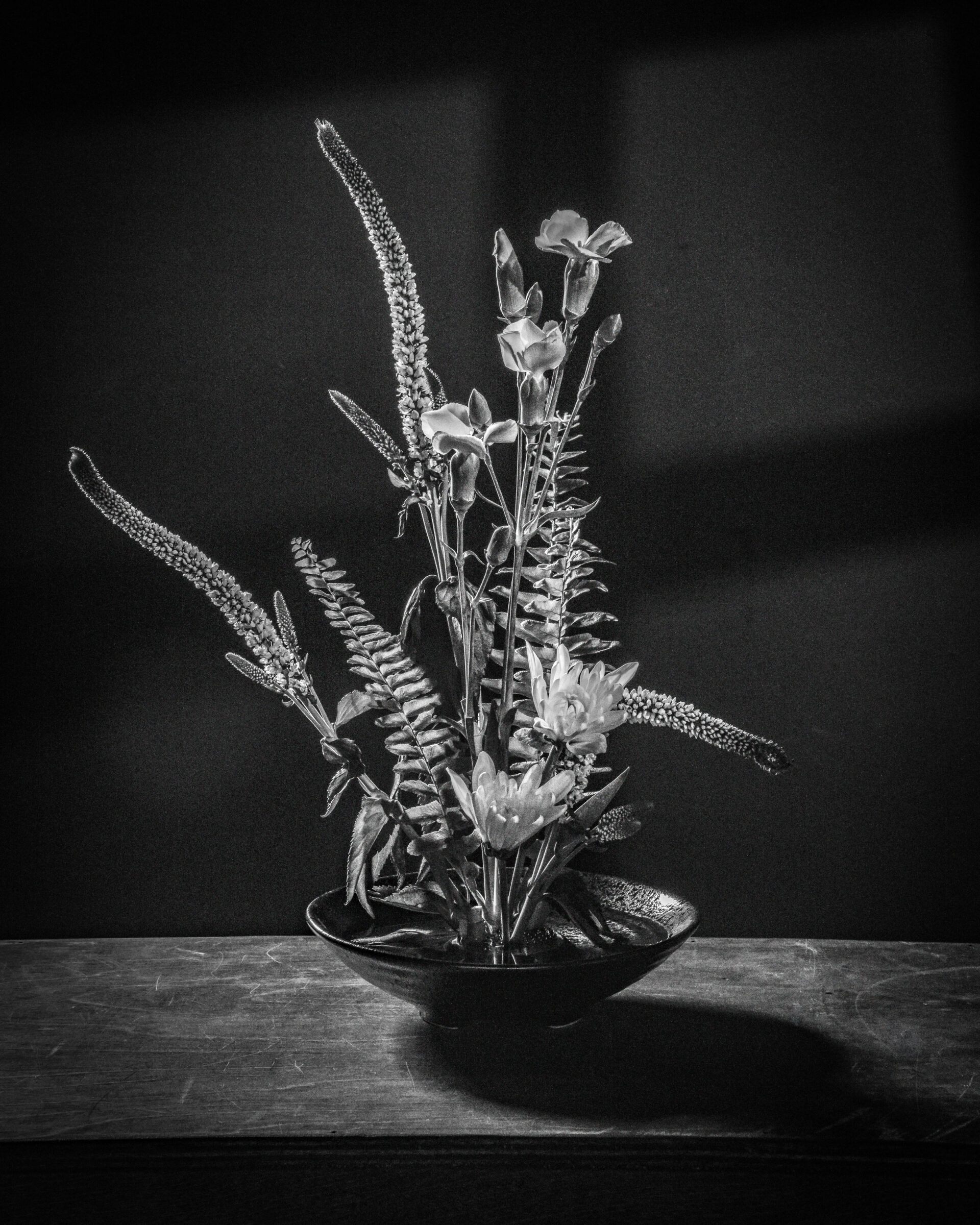
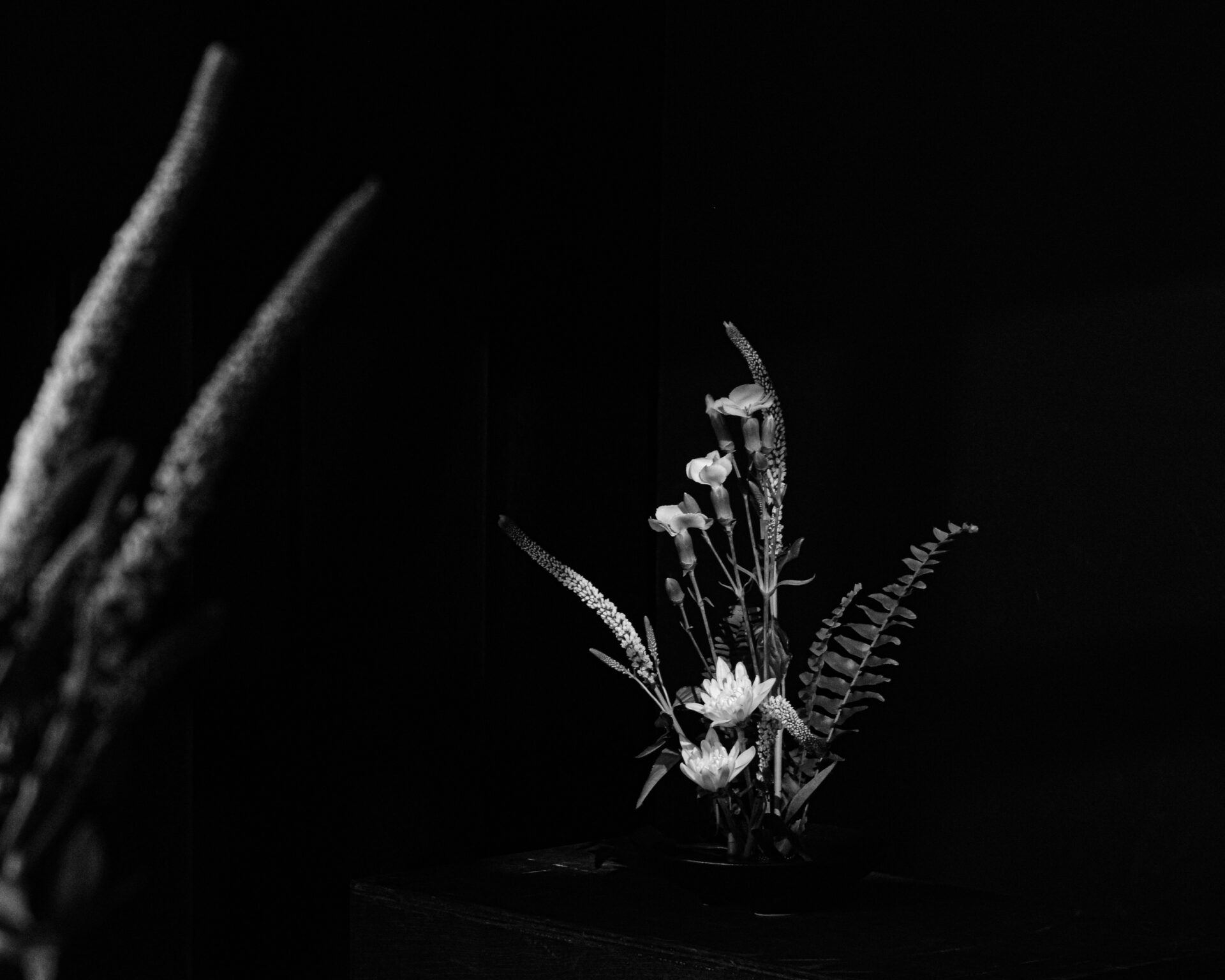
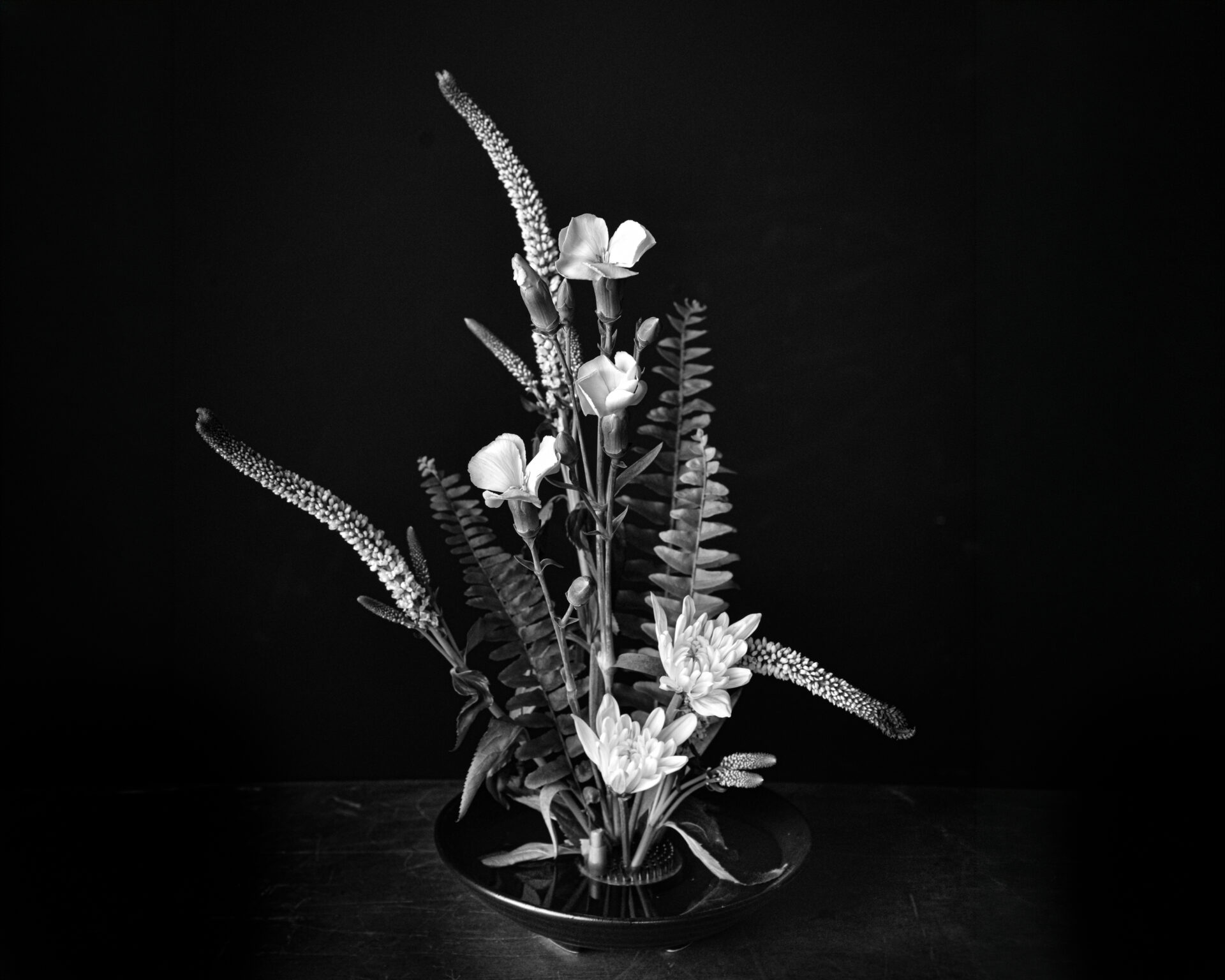
To that end I have explored a variety of composition styles and have grown particularly fond of the art of Japanese flower arranging called Ikebana. It uses an armature based upon a beautiful set of proportions that are calculated upon the tray or pot the flowers will be placed in.
After spending two hours going into great detail about harmonic and dynamic symmetry where I showed baroque lines, sinister lines, reciprocal lines and grids, I just tossed it all away and brought them into the studio where I played with stalks of flowers and greenery and attempted to make a flower arrangement.
It is the idea that matters most to me. That is the armature I rely on most.